
If you’ve priced up enough compost to fill a new raised bed recently, you’ll know one thing…
It isn’t cheap.
Many gardeners are surprised to discover that filling a 2-foot-deep raised bed can require hundreds of litres of compost or topsoil. Depending on the size of your garden, the cost can quickly run into hundreds of pounds or dollars.
But what if there was a better way?
What Is Raised Bed Hugelkultur?
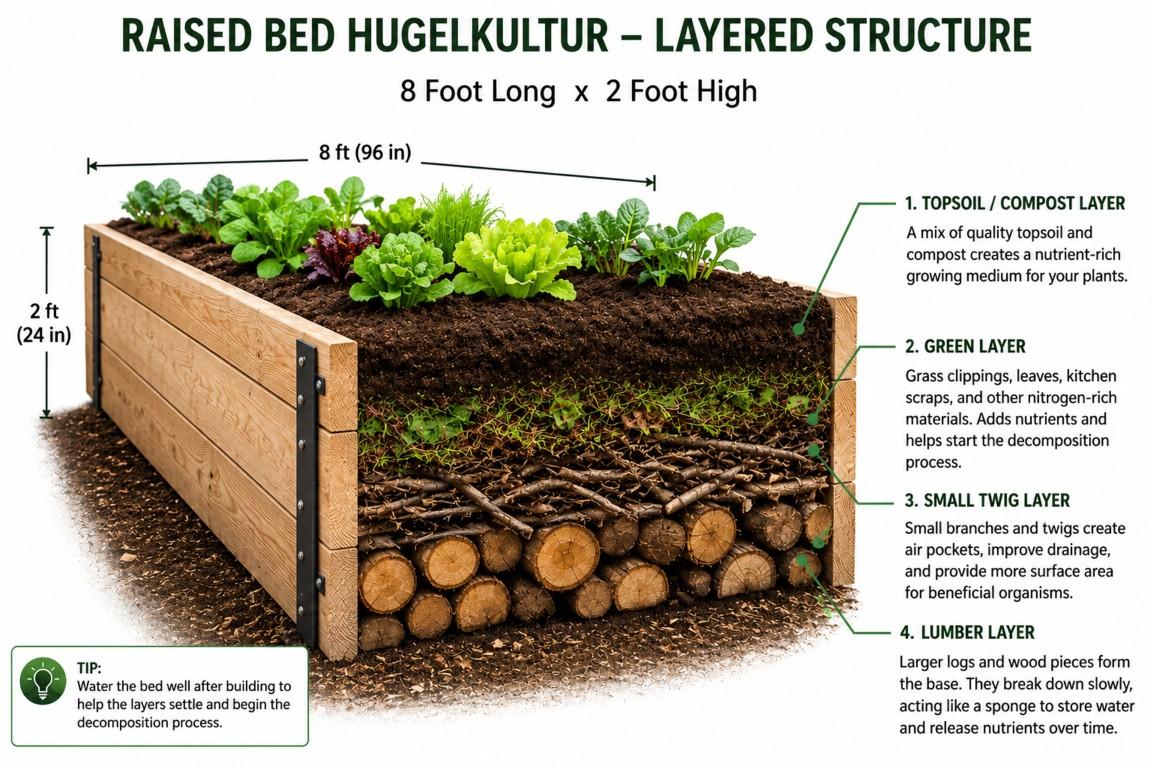
Traditional Hugelkultur is an old gardening technique that uses layers of rotting wood buried beneath the soil to create a fertile growing environment. As the wood slowly decomposes, it improves soil structure, encourages beneficial organisms, helps retain moisture, and gradually releases nutrients over many years.
The method is usually associated with large mounded garden beds.
However, there’s no reason the same principles can’t be adapted for raised beds—and in many ways, raised beds are one of the best places to use it.
Instead of filling an entire raised bed with expensive compost, the lower section can be built using natural woody materials that would otherwise be discarded.
Why Gardeners Are Taking Another Look at Hugelkultur
Modern gardening is becoming increasingly expensive.
Compost, topsoil, timber, fertilisers, and water all cost more than they did just a few years ago. As gardeners, we’re constantly looking for ways to grow more while spending less.
Raised Bed Hugelkultur offers several practical advantages:
- It can dramatically reduce the amount of compost needed to fill deep raised beds.
- It helps retain moisture, reducing watering during dry spells.
- It creates a healthy environment for soil life.
- It recycles natural materials that might otherwise be burned or sent to landfill.
- It continues improving the soil as the buried wood slowly breaks down.
Perhaps best of all, much of the material can often be collected for free from your own garden, tree surgeons, woodland clearances, or neighbours pruning trees.
Is It Suitable for Small Gardens?
Absolutely.
One of the biggest misconceptions is that Hugelkultur only works on large rural properties with huge mounds several metres long.
In reality, the principles work exceptionally well in modest suburban gardens, allotments, and even small vegetable plots.
The key is adapting the technique to fit the space available rather than trying to copy the enormous mounds often seen online.
Not Every Piece of Wood Belongs in a Raised Bed
This is where many online articles oversimplify the process.
Choosing suitable woody material, layering it correctly, balancing green materials with carbon-rich layers, and deciding how deep each layer should be all make a significant difference to the finished bed.
A well-built Hugelkultur raised bed can remain productive for many years, while a poorly constructed one may create unnecessary problems during its early stages.
Understanding these differences before you begin can save considerable time, money, and disappointment.
A Practical Guide for Gardeners
After experimenting with Hugelkultur and researching how it can be successfully adapted for smaller spaces, I decided to write a dedicated guide focused entirely on raised beds.
Raised Bed Hugelkultur for Small Gardens: How to Build Mini Mounds, Fill Raised Beds Cheaply, and Grow More Food in Less Space takes readers step by step through the process, covering:
- selecting the right woody materials
- building effective layered beds
- reducing compost costs
- avoiding common mistakes
- choosing suitable crops
- managing the bed during its first few growing seasons
Whether you’re building your first raised bed or looking for a more sustainable way to garden, Raised Bed Hugelkultur offers a practical approach that can save money while creating healthier, more productive soil.
If you’ve been putting off building raised beds because of the cost of filling them, this may be the gardening method you’ve been looking for. Check out the Hugelkultur book on Amazon here…
Happy gardening!
James Paris
Recent Posts
What is a Hugelkultur Bed? A Hugelkultur bed is a raised garden bed built from rotting logs, branches, grass clippings, leaves, and soil. As the wood decomposes, it stores moisture, improves soil...
Has your philodendron turned into a leafy monster? Whether it’s climbing up the curtains or spreading across the patio, large philodendrons can grow out of control fast. The good news...